

I am/was a massive devotee of Jane Schoenbrun’s sophomore feature I Saw the TV Glow. It made me feel deeply and uncomfortably seen. I often worry that my personality is a collage of the media I consume, worry that there is an absence within me where a self should be that I’ve tried to fill with TV shows, films, books, music, memes, and more. While I can’t honestly say I’ve considered transitioning in a real sense, the allegories and methods Schoenbrun used to depict the difficulties of finding themself and transitioning connected with me; like Owen watching The Pink Opaque, I felt seen, and didn’t know what to do about it except watch the TV glow over and over again.
Needless to say, I came to Cannes eagerly anticipating Schoenbrun’s follow-up Teenage Sex and Death at Camp Miasma, which opened the Un Certain Regard section of the festival ahead of a wide release this August. Unfortunately, health issues affected my first viewing of the film such that I wasn’t able to succumb to Schoenbrun’s vision in the same way I did in the back row of the Sundance screening where I first watched TV Glow. As I heard our team members rave and dissect the film, I stayed quiet, a bit embarrassed that I took away little other than needle drops and painted backgrounds. I say all this to say that Camp Miasma was not really a part of Cannes for me, and exists more as a new indie release I watched at an AMC. It doesn’t make the film itself any different, but it does, of course, change the way I watch the film, just as watching Avatar on a plane is different from IMAX 3D.

Camp Miasma is a markedly bigger and more ambitious feature than TV Glow. It stars Hannah Einbinder fresh off an Emmy win for Hacks and the ever-present Gillian Anderson, along with Sarah Sherman and Eva Victor in supporting roles. It spans multiple locations. There is gore and blood and oners and (remarked-upon) split diopter shots. There is just more. The narrative, too, tackles more than Schoenbrun’s prior efforts, in ways that complicate and deepen Camp Miasma’s project.
Einbinder’s Kris is an indie filmmaker tasked with rebooting the flagging “Camp Miasma” franchise that seems to sit somewhere between Nightmare on Elm Street and Sleepaway Camp in scope and success. Like Elm Street, the franchise has stretched from analog to digital, with its own Krueger-esque slasher icon Little Death (played brilliantly by TV Glow alum Jack Haven) having crossover success in the 80s and 90s before falling into bargain bins, adventures to space, and 3D remakes. Camp Miasma’s winks at horror history have warmed the hearts of horror fans (like Baby Critic’s Colin Kerekes, whose review from Cannes focuses more on these themes and their impact). Being a horror novice, though, I found these references to be fun window dressing. You don’t have to be a horror obsessive to appreciate Camp Miasma, but, as with TV Glow, lived experience helps to buy into Schoenbrun’s vision.
Like Angela in Sleepaway Camp, transness is essential to Little Death’s story—spoofing the bluntness of trans characters in the 1980s, Haven’s Little Death is literally sliced between male and female, their gender made spectacle and turned into the impetus for their rage. It’s Little Death’s sequences that make Camp Miasma sing, when Schoenbrun flexes their filmmaking muscles and eye for the most base of thrills. Who doesn’t love a killing spree choreographed perfectly to a Counting Crows classic? There is certainly subtext to be found throughout this sequence in Haven’s gesture and expressions. Schoenbrun can’t give that up. But the thrills, or as Billie might say, “flesh and fluids” of the sequence, take precedent.
It is probably reductive to say that I want Schoenbrun to make an unmediated and delightfully gory slasher, given that mediation has become their artistic signature. Everything is thought and rethought. Take the other main narrative thread of the film: Kris’s sexual acceptance. Kris overthinks her sexuality, never fully able to let herself go unless she fantasizes being a bimbo slasher victim running away from a killer, like Billie in the first “Camp Miasma” film. This desire to, in a sense, be Billie is what pursues her to find Billie in the first place. The resolution to Kris’s frustration arrives in a surrealist sequence where she is placed into the “Camp Miasma” universe, the star of her own horror film. In dying by Little Death’s hands, Kris heals something within herself, succumbing to orgasm’s corporeal pleasures.
Similarly to Little Death’s first killing spree, there are cinematic delights to be found here. But the whole thing feels a tad bit too cutesy and contrived. Instead of Little Death’s victims being camp counselors in the first sequence, they are figures from Kris’s life—her romantic partner and her partner’s partner, her squash-playing agent, her skeptical and patronizing executive team—adding to the surreality. But these characters don’t work in the first place. When they appear in the narrative, they feel ripped out of an Entourage spoof, and not a particularly well-considered one. I’m sure that Schoenbrun has met a shallow and uncreative Hollywood executive in their time since TV Glow. I’m not sure that their inclusion in Camp Miasma, especially when they only live to die, is necessary. The payoff isn’t worth the investment.
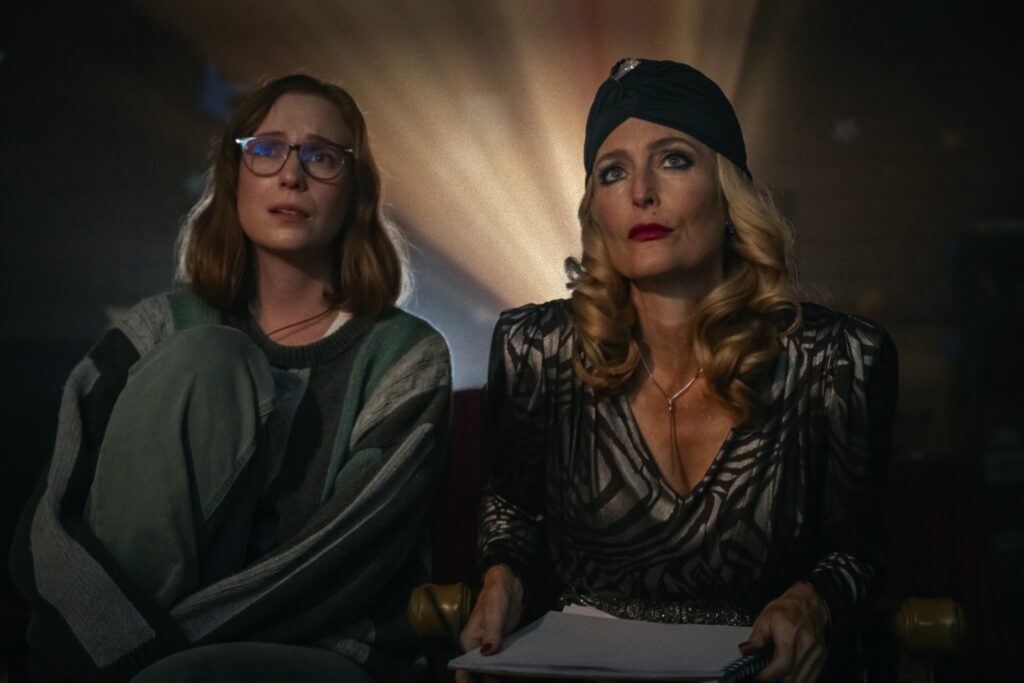
Another place that feels a bit deflated is unfortunately Hannah Einbinder’s performance. Einbinder has become one of the quintessential young comedic faces of the 2020s. Ava Daniels on Hacks acts as a great foil to the rigor and brashness of Jean Smart’s Deborah Vance, and Einbinder has grown into the role tremendously. Ava and Deborah have an unconventional chemistry, one that has reaped rewards for both actresses. Camp Miasma attempts something similar, pairing Einbinder’s academic and mousy Kris against Gillian Anderson’s teasing and gaudy Billie.
The dynamic between the two works best in moments where Billie ribs Kris for their intellectualization of horror and reluctance to share personal details. Einbinder plays this discomfort well, along with the quiet and guilty confession of desire later in the film. There’s a glint in her eye and her whisper that makes the viewer feel like we’re at a late night sleepover playing a game of Never Have I Ever. It’s pretty brilliant.
But when Kris is supposed to come into her own and become the final girl, Einbinder carries too much of the discomfort with her, unable to fully surrender to the raw feeling required of her. To a degree, this is the point: Kris is on the beginning of a journey towards acceptance, and that can’t happen overnight. Still, it diminishes the effect. I wanted to see full surrender and embodiment. What I got felt like a first take.
Anderson, on the other hand, is superb. A fusion between Norma Desmond and Anne Hathaway’s Rebecca in Eileen, she chews through the painted backdrops and horror memorabilia with a fully embodied self. We feel her reluctance with leaving the safety of her cabin and her desire to aid Kris. It’s a treat to see Anderson have a film role this delicious. Her star has shone on the small screen since the 90s, but for some reason it has not translated to film in the same way, especially in the past fifteen years. If we lived in a just world she would be getting Oscar buzz, a la Amy Madigan in Weapons.
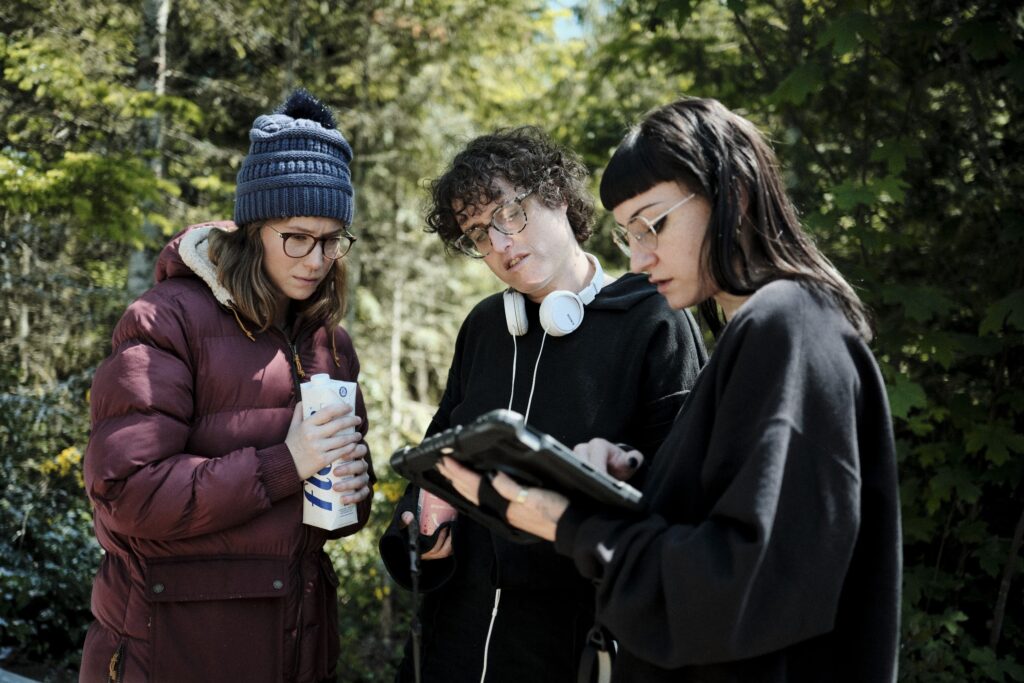
There is a saying in Hollywood that directors and actors operate with a “one for them, one for me” mindset. One for the executives, the masses, the money, and one for the arthouse, the critics, themselves. Teenage Sex and Death at Camp Miasma interrogates and perpetuates that notion in equal measure. In taking on the beleaguered “Camp Miasma” franchise, Kris attempts to blend the two, telling their story of queer delight within the confines of the franchise. However, she is only able to in the surrealist fantasy, the world where executives get gutted like fishes.
This same dichotomy rears its head off-screen. Schoenbrun discussed in an interview with The Hollywood Reporter how A24, their prior home, passed on Camp Miasma, and how only Mubi gave them the green light and funding they needed to level up from TV Glow. In an interview with Deadline, they also commented on their position within the industry, saying that Camp Miasma’s Hollywoodisms evince “some of the tensions of being the one trans person who actually gets money to make things in Hollywood.” Schoenbrun occupies a simultaneously enviable and difficult position in moviemaking. To be able to fulfill one’s creative vision on the scale that Camp Miasma operates on is a privilege. But when you’re standing alone as the only trans filmmaker able to command that price tag, it’s lonely. Camp Miasma is a simultaneous pitch down the middle and a personal meditation—because it’s trying to be both, there are some elements, like the depiction of the movie pitching process and Einbinder’s loose grip on surrender, that get a bit muddy.
I’d never want to diminish Jane’s vision, and I’m so happy that a film like Camp Miasma exists for the people it works for. For me, though, it sometimes feels like Jane holds their audience’s hand too much. We all know Little Death is an orgasm euphemism, right? Was that supposed to be subtle? And do we really need a Sade song to set the mood during the crosscuts of the final sequence? Maybe if I surrendered to the flesh and fluids I would have a better time, let the satire wash over me and call the discordance camp. But Camp Miasma, for all its insistence to the contrary, seems reluctant to let the viewer do just that. Maybe it comes from Schoenbrun’s discomfort with their position, or a quiet fear that, if the audience finds Camp Miasma and its movie-within-a-movie and fantasy murders too confusing, the film won’t succeed financially or critically.
Or, and this is something I’m still unsure about, maybe the repeated Norma Desmond callouts, the split diopter shouts, the obvious Hollywood executive jokes, are there as easy bait for a fandom-minded viewer, one who is eager to post screenshots on Twitter or get likes on their Letterboxd review. Schoenbrun is incredibly clued into the world of fandom, as evidenced throughout TV Glow and the encyclopedic and visually stunning title sequence of Camp Miasma. Often within these fandom spaces, though, recognition and identification of references supersede good storytelling. The line between commenting on and participating in fandom becomes incredibly thin here in a way that left a bit of an odd taste in my mouth.
I liked so much of Camp Miasma, and a lot of my quibbles with it are not things I felt in the theater. There is incredible confidence and mastery in the craft of the film, and the narrative swings all pay off in spades. But unlike TV Glow, I didn’t feel uncomfortably seen in the film. I don’t have a desire to rewatch it over and over again. That’s totally okay! Not every film is for every person, and it shouldn’t be. It’s the double-edged sword of making films that are so committed to a specific audience: sometimes people who aren’t in that audience find their way in and try to fit a square peg into a round hole. I hope, in their next film, Schoenbrun makes something even more alienating, something that wears its references with pride and is not afraid that it will be misunderstood. Camp Miasma aims to be understood by everyone, even at the cost of sacrificing those who would have understood it all along.
Teenage Sex and Death at Camp Miasma is in theaters now.