
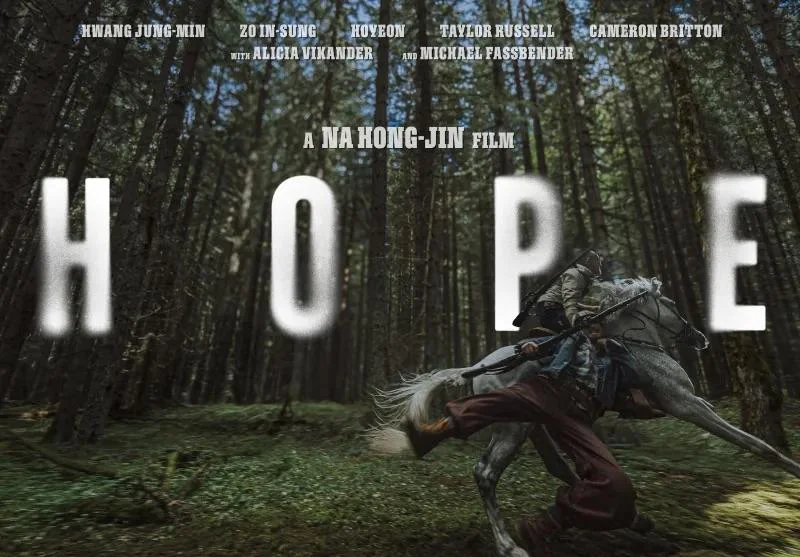
The first paragraph is my spoiler free review of Na Hong Jin’s “Hope.” The rest is riddled with spoilers.
You decide to ride the new rollercoaster designed by a world renowned imagineer. After waiting in the hourslong queue, you get on. It’s exhilarating. As the coaster swoops and dips, you marvel at the magic trick; this machine makes everyone feel the same thing at the same time – fear, exhilaration, adrenaline – everyone’s hearts now beat in tune. Then. Just before the final drop, someone stands up from their harness and gets decapitated by a support strut. Pulverized cartilage drips in your hair. Your little sister is crying, blinded by a flying shard of jawbone. The police need to keep you there for witness statements. Did the joy you felt in the beginning matter at all, under these circumstances? Can you even remember?
Na Hong-Jin’s “Hope” was the most divisive film at the festival this year, with reactions ranging from Deadline’s “rip roaring action cult classic” to Indiewire’s “trite and tedious.” It’s a far cry from the writer/director’s most recent film, “The Wailing,” (2016) which debuted to near universal acclaim for its masterful, genre-breaking story about a cop caught up in a supernatural battle between good and evil. After watching The Wailing, I can see why Na Hong Jin was able to raise the largest budget in Korean cinema history for “Hope”. But somehow, it wasn’t enough.
At the Cannes press conference the next day, Director Na entered damage control mode. He said that they had rushed the CGI in order to have it ready for Cannes, and the film’s sound is unfinished. As soon as the festival was over he would get back in the studio and fix things.
He certainly changed things, but there are no indications that the film is, in a word, fixed. As of the time of this writing, a new cut with about five minutes removed was released in Korea, opening to the best Korean box office opening this year. It also activated a new, fresh wave of haters. One prominent Korean reviewer, Lee Dong-Jin, gave the film a glowing four out of five star review. This unleashed a torrent of vitriol from the Korean moviegoing public, with many speculating he must have been bribed. Online hate is obviously not the best way to measure the quality of a film, I’m bringing it up only to illustrate a phenomenon we don’t often see: people went into this movie expecting something great. They left enraged.
I walked into the Cineum with all the disappointed tweets bouncing around in my head. I had high hopes–negatively polarized against the snobby Cannes critics who would never give Pure Action a chance. I can forgive a few sloppy vfx shots: I loved “Furiosa” despite obvious seams between the set and the blue screen. I can forgive a dumb monster design: “Signs” still frightens me with the most generic alien design imaginable. And god forbid a movie is pure action. I adore action cinema. Fury Road. Sisu 1 and 2. The Raid series. Point Break. The John Wick series.
Then I watched it.
The action in Hope was spectacular– for about an hour. If “Hope” ended at exactly 62 minutes in, it would be considered one of the greatest action movies of all time. Hope taught me that 62 minutes is the exact amount of time I can watch immaculately crafted violence without any context whatsoever. After that, the action evokes the same emotional reaction as watching my cousin play Call of Duty.
“Hope” is named after the town in which it is set: Hope Harbor, a small coastal village by the North Korean border. Anticommunist propaganda and minefield warnings are posted everywhere. It begins with Hope Harbor’s sheriff, Beom-Seok (played by Hwang Jung-min), investigating an eviscerated cow carcass in the middle of the road. A few hunters pull up and assume that it was killed by a tiger that crossed the mine infested border zone. Everyone, including the sheriff, goes along with this unfounded assumption. This opening quickly establishes the provincial vibes of the principal characters; they’re a bunch of hunters and fishermen who live off the land, and hunting a tiger is the most excitement they’ve had in a while. They’re quick to judge, quick to act, and slow to question their assumptions.
So far so good. The set design and script set up a story about mob mentality, fear of the other, and maybe a little hubris. The director has said in interviews that that’s what he was going for. All semblance of that story is abandoned as soon as the sheriff returns to town.
When he gets back, a gigantic plume of smoke emerges from the horizon. The streets are empty save for twisted rebar and scattered human limbs. For about forty five minutes, we follow Beom-Seok as he hunts and is hunted by the monster. Whatever the fuck is going on is way way above our hero’s pay grade, and he knows it. Hwang Jung-min’s performance combines overwhelming fear and a heroic compulsion to move forward in the face of it. During his hunt for the monster, his breaths are shallow, his movements jerky, and he swings his gun wildly toward any noise he hears. I was afraid for him every time he turned a new corner.
Much of the tension in the first act derives from the impeccable environmental storytelling in the production design, which is some of the best I’ve ever seen. Lee Hwokyoung and the team made every shattered building, every bloodstain, every hastily abandoned car and shop feel tactile, and viscerally real. I could practically smell the fish market amidst the blood and smoke. The design of this sequence becomes all the more impressive through the crispy, full daylight, wide angle cinematography. There’s no soft focus to hide behind; the monster could emerge from every corner of the frame.
Then the monster emerges.
Much of the criticism has been centered around the CGI that was unfinished at the Cannes premiere. At times, the creatures move around at a noticeably different framerate from the rest of the action, which created the jittery, jarring look. Director Na has said that this was a deliberate choice to give the creatures an inhuman quality, but it has the effect of making them seem like they were simply rendered poorly. The design of the monster does not help. The first alien looks like a scaled up default zombie model from Unreal Engine’s free assets page. The tragedy of this film is that the VFX is only such a problem due to the irreproachable craft in the real life sets, and sharp photography.
If you keep reading, please understand that I will be spoiling the hell out of this movie. I find it hard to write about “Hope” without spoiling its ending, because it is simply the worst ending I have ever seen in a movie. It’s the first time I have disliked an ending to the extent that it lowered my opinion of everything that came before it, up to and including my arrival at Cannes.
The monster emerges, and Beom Seok runs for dear life as the unkillable creature destroys everything in its path in order to get to him. In this, the most memorable sequence of the movie, the physical sets and VFX are incorporated well.
But as soon as Ho-Yeon drifts into the movie in her police cruiser and 10 foot tall machine gun and underbarrel grenade launcher, the movie reveals its aspirations as the pinnacle of lizard brain cinema. The hot girl from Squid Game shoots her machinegun, then goes Ka-thunk boom with her grenade launcher. This moment is the beginning and the end of her character arc. I challenge you to watch this movie, then tell me one thing about the character afterward. She shoots the thing for a while, shoots a grenade, and it gets stunned. They drive away, see that the thing has woken up, shoot it for a while, shoot a grenade, it gets stunned again. Then, as she’s pumping bullet after bullet into this creature, the camera goes slo-mo. We zoom into the creature’s eyes– What’s this? It’s crying!
The sheriff sees that the creature could be expressing something akin to human emotion. So what do they do with this new information? Nothing. Literally nothing. I think at one point the sheriff says to someone, “I think I saw it crying.” And it changes nothing about any of the characters’ behavior. They proceed to shoot it more. This is the first instance of the problem which hobbles the rest of the film: after the first hour, there is no character growth nor plot development. For the next hour and a half, they shoot at the creature until it counterattacks, at which point they run, gain some distance, and shoot the creature again, until it counterattacks
“Is that important right now?” is a mantra the characters repeat several times over the course of the film. An early example: A bunch of elderly residents drive by the sheriff in a pick up truck. It inexplicably has a mounted machinegun on it, and a bed full of automatic weapons. He asks them “Why do you have all these?” and they respond, “Is that important right now?” With stunned silence, he concedes that it isn’t important. There’s a big monster roaming the streets.
Whenever something absurd happens, like when the village is armed to the teeth, or when his deputy rocks up multiple US military grade assault rifles and an unlimited ammo hack, or a fisherman shoots an AK-47 from a horse while hanging from the side of his horse like Venom Snake, a character does the reasonable thing: they ask “How is this possible?” Then another character responds: “Is that important right now?” Director Na does everything he can to tell the audience, “Don’t think about it too much, just go along. Enjoy the spectacle, aren’t the explosions cool?” But even in the dumbest of action films, the most stultifying bits of popular entertainment, the heroes undergo some growth, positive or negative. The characters have emotions that can be recognized as human. Their lives mean something in the world of the film. This does not happen in “Hope.”
Director Na has stated that he took structural inspiration from Jaws, which perfected the creature feature and pioneered the summer blockbuster. The parallels are clear: small town sheriff protagonist in over his head, an isolated coastal community that bands together to overcome a crisis. The unseen antagonist lurks at the edge of every watery frame, a conceit that Hope borrows in all of its tense moments.
What “Jaws” has, and “Hope” lacks, is growth. “Hope” revels in its spectacular stagnation. In “Jaws”, the sheriff and his ragtag group change their approach three or four times. Different factions of the town have different solutions. The mayor wants to ignore it. Quint claims he can kill it. All while bodies pile up. In “Hope”s tedious slog of a second act, the characters simply hold down their triggers until their guns are empty, then reload from their infinite supply and do it again. They fill the alien’s stun meter over and over again. Imagine “Jaws” without any scenes in town, or any conversations between the main characters on the boat. Imagine no words, just shooting at the shark for two hours. Imagine if, at the end of those two interminable hours, that the shark is not blown up in a cathartic, stand-up-and-cheer moment, but rather, the shark swims away and addresses the camera in subtitled Shark-to-English translation: “You may think me a monster now, but in Jaws 2, you shall see that Humanity is the true monster.”
The ending left me with permanent psychic damage. They had the audacity to end this completely empty shell of a movie with the promise of more. The movie does not end, in any traditional sense. It just stops. In the last ten minutes, one of the main characters of the film is unceremoniously killed. It’s played for laughs, because nothing in this film is supposed to be taken seriously. Then we cut to the aliens in a section that feels a lot like the audience is supposed to be taking it seriously. Their mothership inexplicably crashes to earth. There was no prior mention or indication that a mothership might exist. Then the aliens start speaking to each other. The alien language is translated for the benefit of the viewer. The Michael Fassbender alien says shit like, “The Prince’s heart will save the kingdom.” Then the Alicia Vikander alien responds, like “We have the strength to rebuild the Mei’ Mou Va Laar.” Then the human protagonists run out of gas. They run down a road. Roll credits. A mid credits scene reveals that the guy who died five minutes ago has respawned and is to join the gang in Hope 2. In the bathroom mirror after the film, I noticed my skull had gone slightly concave, as if struck by an aluminium bat.
In 2019, Martin Scorsese famously compared the films of the MCU to theme parks. This prompted outrage from many MCU filmmakers and their fans, most of whom argued that their favorite franchise was more than just an amusement park ride. They argued that Marvel films evoke real emotional responses from their audience, and attempt to display genuine humanity in between moments of multimillion dollar VFX spectacle. Whether it succeeds is a matter of opinion; the fact is, the filmmakers are trying. “Hope” does not seem to be trying. Hope wants to be a theme park ride, and it succeeds. Take a 10 mg edible, watch it in 4DX, and embrace the lizard brain. It’s fun for a while.